
Every month, puppies and kittens die from parvovirus and feline panleukopenia across Lahore and Karachi. These are not rare, exotic diseases. They are common, circulating, and entirely preventable – if the vaccination schedule is followed.
Yet a significant number of Pakistani pet owners either skip vaccinations completely, give the first injection and never follow up, or simply don’t know what their pet needs and when. Some assume one round of shots as a puppy or kitten is enough for life. Others believe their indoor pet is safe without it. Neither is correct.
This guide, put together by the team at Zia Vet Clinic, covers the complete vaccination schedule for dogs and cats in Pakistan – from the first injection at six weeks through to annual boosters in adulthood – along with what each vaccine actually protects against, why Pakistan’s disease environment makes this more urgent than in many other countries, and which common beliefs about pet vaccination you need to stop trusting.
Why Vaccination Matters More in Pakistan Than You Might Think
Pakistan is classified as a high-rabies-risk country by the World Organisation for Animal Health. With millions of unvaccinated stray animals circulating through every major city, the baseline exposure risk for pet dogs and cats in Lahore and Karachi is meaningfully higher than it is in most parts of the world.
Parvovirus still kills puppies in DHA. Distemper still circulates in Johar Town. Feline panleukopenia – which functions almost identically to parvo in cats – is widespread in Karachi’s urban environment. These are not worst-case scenarios. They are routine clinical findings at any active small animal practice in Pakistan.
What makes this worse is that several of these diseases spread through environmental contamination, not just direct animal-to-animal contact. Parvovirus can survive on soil, grass, and hard surfaces for months. Your dog does not need to encounter an infected dog to pick it up – it can happen on a morning walk. The same logic applies to your cat, even one that rarely leaves the apartment.
Rabies vaccination is now a legal requirement for pet dogs and cats in Pakistan. Beyond the legal dimension, it is simply an unavoidable protection given where we live and what the disease does. There is no treatment for rabies once symptoms appear. Vaccination is the only meaningful intervention.
Core vs. Non-Core Vaccines – What Do These Terms Actually Mean?
Before going into schedules, it helps to understand the two categories every veterinarian in Pakistan uses when discussing vaccination.
Core vaccines are recommended for every dog and every cat, regardless of lifestyle, breed, or how rarely they go outdoors. The diseases these vaccines protect against are either uniformly life-threatening, highly contagious, or zoonotic – meaning they can pass from animals to humans. In Pakistan, core vaccines are not optional.
Non-core vaccines are given based on individual risk assessment. A dog that frequently boards at kennels may need a Bordetella (kennel cough) vaccine. A cat with outdoor access may benefit from a Feline Leukaemia Virus (FeLV) vaccine. A dog with significant outdoor exposure in flood-prone or agricultural areas may need Leptospirosis protection. Your vet discusses these after reviewing your pet’s lifestyle.
Zia Vet Clinic follows the guidelines of the World Small Animal Veterinary Association (WSAVA), the internationally recognised standard for small animal vaccination protocols. This means every vaccination plan is evidence-based, and the clinic does not overvaccinate – a practice that does more harm than good.
Complete Puppy Vaccination Schedule in Pakistan
The First Year – What Your Puppy Needs and When
The schedule below reflects WSAVA-aligned practice as applied in Pakistan. There can be minor variations based on the specific vaccine brands available and your puppy’s individual health status, but the structure is consistent across reputable small animal clinics in Lahore and Karachi.
At 6-8 Weeks:
Your puppy’s first core vaccination. This typically covers Canine Distemper, Parvovirus, and Adenovirus (Hepatitis) in a single combination injection – commonly known as the DHPPi or Hexadog vaccine. At this age, maternal antibodies passed through the mother’s milk are beginning to decline, opening a critical window of vulnerability. Missing this appointment leaves your puppy exposed at the age they are most at risk. You can read more about what parvovirus does to unvaccinated puppies in our canine parvovirus guide.
At 10-12 Weeks:
Booster dose of the core combination vaccine. This is not a repeat for the sake of repetition – it is part of a sequential series that builds layered immunity. Some protocols also introduce Leptospirosis at this stage, particularly for dogs with any outdoor exposure.
At 14-16 Weeks:
Final booster of the core combination vaccine, plus the Rabies vaccination as a separate injection. This completes the primary series. After this point, your puppy has built meaningful, clinically significant immunity against the diseases that are most prevalent and most lethal in Pakistan.
At 12-16 Months:
A booster across all core vaccines, including Rabies. This round is frequently skipped by owners who consider the job done after the puppy series – it is not. Immunity built during puppyhood needs reinforcement to sustain itself through adulthood.
Annually After the First Year:
Rabies boosters are given annually in Pakistan given the country’s disease burden. Other core vaccine boosters – distemper, parvovirus, hepatitis – may be given every one to three years depending on the specific vaccine formulation and your vet’s assessment of your dog’s exposure level.
Complete Kitten Vaccination Schedule in Pakistan
The First Year – What Your Kitten Needs and When
Kittens are born with some maternal immunity, but it fades – and fades faster than most new cat owners expect. Here is the standard kitten vaccination schedule followed at quality small animal clinics across Pakistan.
At 6-8 Weeks:
First dose of the FVRCP vaccine – protecting against Feline Viral Rhinotracheitis (Herpesvirus), Calicivirus, and Panleukopenia. Feline panleukopenia is the cat equivalent of canine parvovirus. It is equally devastating and spreads through similar routes. Our detailed breakdown of feline panleukopenia covers the disease and why it remains a serious threat in Pakistan’s urban environment.
At 10-12 Weeks:
Second dose of FVRCP. Sequential doses build upon one another – skipping the second defeats the purpose of the first.
At 14-16 Weeks:
Third FVRCP dose (recommended in higher-risk environments) plus Rabies vaccination. This completes the primary series for most kittens.
At 12 Months:
Boosters for both FVRCP and Rabies.
Annually After the First Year:
Rabies annually. FVRCP every one to three years depending on vaccine formulation and your cat’s lifestyle – outdoor cats are typically boosted more frequently than indoor-only ones. Cats with outdoor access may also be assessed for the Feline Leukaemia Virus (FeLV) non-core vaccine at this point.
Do Indoor Pets in Pakistan Really Need Vaccination?
This is the most common reason Pakistani pet owners give for skipping vaccines – and it is worth addressing directly, because the logic sounds reasonable but doesn’t hold up in the Pakistani context.
On parvovirus: The virus is shed in the faeces of infected animals and can survive on shoes, clothing, hands, and floors for months. You do not need to take your unvaccinated dog anywhere for contamination to reach them. You can bring it home without knowing. The same principle applies to your cat, even one that never leaves the apartment.
On rabies: In Pakistan’s cities, bats are a meaningful rabies vector. They enter homes through ceiling gaps, ventilation openings, and open windows more often than most residents realise. A bat inside the house is a direct rabies exposure risk for an unvaccinated indoor cat.
On feline panleukopenia: It is environmentally persistent in Pakistan’s urban areas. It arrives via contaminated surfaces, new pets introduced to the home, or items carried in from outside. Indoor-only status significantly reduces – but does not eliminate – the risk.
The honest position is this: “indoor” is a risk modifier, not a risk eliminator. And in Pakistan, where the baseline disease burden is already high, a reduced-but-not-eliminated risk is not good enough justification for leaving your pet unprotected.
If you’re scheduling a wellness examination for your pet, your vet can review vaccination status and close any gaps in the same visit.

Common Pet Vaccination Myths in Pakistan – Addressed Directly
“One set of puppy or kitten shots covers them for life.”
It does not. Immunity from early vaccines wanes over time. Annual or triennial boosters – depending on the vaccine – are required to maintain protection. A pet that received vaccines at eight weeks and nothing since is not protected.
“Natural immunity is better than vaccination.”
To develop natural immunity to rabies, distemper, or parvovirus, your pet would need to survive the infection. Most do not. Vaccination builds the same immune memory without the life-threatening exposure.
“Vaccines can cause the disease they’re protecting against.”
The vaccines used in Pakistan for dogs and cats are killed-virus or modified live-virus formulations. They cannot cause the diseases they protect against. Mild lethargy or injection-site tenderness for a day or two is a normal immune response – not an illness.
“Senior pets don’t need vaccination anymore.”
Older pets are often more vulnerable to infection because immune function declines with age, not less vulnerable. Unless your vet identifies a specific medical reason to defer, elderly pets should stay on schedule. A pre-vaccination health assessment helps identify any such concerns.
“If my pet looks healthy, their immunity must be fine.”
Health and immunity are not the same thing. An unvaccinated pet can look entirely healthy while being completely unprotected. Parvovirus, in its early stages, looks like general fatigue or a mild stomach upset.
What to Expect at Your Pet’s Vaccination Appointment
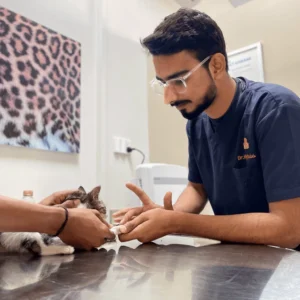
A vaccination visit at Zia Vet Clinic is not just an injection. Here’s what actually happens:
Pre-vaccination health check. Every visit begins with a brief clinical assessment – temperature, weight, and an overall condition review. A pet with a fever, active infection, or significant underlying illness may need their vaccination deferred until they’re stable. This is done for their protection.
The injection. Most vaccines are administered subcutaneously – just under the skin. The process takes under a minute, and the vast majority of pets tolerate it without any distress.
Brief post-vaccination observation. Serious allergic reactions to vaccines are rare, but monitoring for the first few minutes after injection ensures any reaction is caught immediately.
Your vaccination record card. You’ll leave with a documented card recording what was administered, the batch number, and the date the next dose is due. Keep it. It will be asked for at grooming appointments, boarding facilities, housing society gates, and any future vet visits.
If you’re also thinking about international pet travel, your vaccination record is a foundational document for the process. Rabies vaccination is required for export from Pakistan, and microchipping is a parallel requirement in most destination countries – our microchipping service and travel assistance team handle both.
What Happens If You Miss a Booster?
A short gap – a few weeks overdue: Not a serious problem. Administer the booster at the earliest opportunity. Immunity is unlikely to have lapsed significantly.
A medium gap – several months overdue: Your vet will assess whether existing immunity is likely still adequate, or whether repeating part of the series is the safer route. This depends on the specific vaccine and how long the gap has been.
A long gap – over a year without vaccination: Treat it as a restart. Assume immunity has lapsed and discuss a full primary course with your vet. This is particularly important with rabies, where a lapsed vaccine has both health and legal implications in Pakistan.
If you’re unsure of your pet’s vaccination history, common with adopted or rescued animals, bring any records you have and let the vet assess from there. When in doubt, starting fresh is always the correct approach. The risk of over-vaccinating is minimal. The risk of assuming immunity that doesn’t exist is not minimal.
Frequently Asked Questions About Pet Vaccination Schedule
At what age should I start vaccinating my puppy in Pakistan?
Vaccination begins at six to eight weeks – the point at which maternal antibodies from the mother’s milk start declining, creating a window of vulnerability. Do not wait until your puppy is three to four months old. The risk window opens early, and parvo in particular is highly lethal in young, unprotected puppies.
Do cats in Pakistan need vaccination every year?
Rabies boosters are recommended annually for cats in Pakistan given the country’s high-risk status. The FVRCP core vaccine may be given every one to three years depending on the vaccine formulation and your cat’s lifestyle. Your vet will advise the right interval at each visit.
Is rabies vaccination mandatory for pets in Pakistan?
Yes. Rabies vaccination is legally required for pet dogs and cats. In Lahore and Karachi, pet licensing and housing society requirements are increasingly tied to proof of current vaccination. It is also a non-negotiable requirement for international pet travel documentation.
Can my unvaccinated puppy go outside?
With precautions only. Before completing the primary series, your puppy is not adequately protected. Avoid dog parks, shared green areas, and contact with unknown dogs. Your own enclosed garden – where no unvaccinated dogs have recently been – carries lower risk. After the primary series is complete at approximately 16 weeks, you can gradually introduce broader outdoor exposure.
What are the normal side effects after pet vaccination?
Most pets show none. Some experience mild lethargy, a low-grade fever, or tenderness at the injection site for 24 to 48 hours – this is the immune system responding normally. Serious allergic reactions are rare and typically appear within the first 30 to 60 minutes after vaccination, which is why a brief post-vaccination observation period matters.
What if I don’t know my rescue pet’s vaccination history?
Assume unvaccinated and begin a primary series from scratch. This is the conservative, correct approach. Even if prior vaccines were given, you cannot rely on unknown immunity. Starting fresh is always safer than assuming protection that may not exist.
What is the difference between the Hexadog and Rabies vaccine for dogs?
The Hexadog is a combination vaccine protecting against Distemper, Hepatitis, Parvovirus, Parainfluenza, and two strains of Leptospirosis – six diseases in a single injection. The Rabies vaccine is a separate injection for the rabies virus specifically. Both are core vaccines for dogs in Pakistan and are often given at the same visit but as separate injections.
Can I vaccinate my pet using vaccines from a pet shop?
This is strongly discouraged. Vaccines require an unbroken cold chain from manufacture to administration – a temperature breach at any point renders the vaccine ineffective, and you have no way to verify the storage conditions of a product bought from a pet shop or market. Beyond storage, a pre-vaccination health check ensures your pet is well enough to receive the injection and that the right vaccine is chosen for their specific situation.
How much does pet vaccination cost in Pakistan?
Costs vary by clinic and vaccine brand. A complete puppy or kitten primary series at a reputable clinic in Lahore or Karachi typically ranges from Rs. 6,000 to Rs. 15,000 for all doses through the first year. Annual booster visits cost considerably less. Contact Zia Vet Clinic directly for current pricing at your nearest branch.
Is deworming connected to my pet’s vaccination schedule?
Yes, deworming and vaccination often go hand in hand as part of your pet’s broader preventive care routine. A heavy parasite load can suppress the immune system and reduce how effectively a vaccine works. Our deworming service page has more on the recommended schedule.
Your Pet’s Vaccination Is One Appointment Away
A vaccination schedule only works if you keep it. One missed booster can undo months of protection – and in Pakistan, where rabies, parvovirus, and feline panleukopenia are still actively circulating in the environments where our pets live, the gaps genuinely matter.
Zia Vet Clinic offers pet vaccination services across three branches – DHA Lahore, Johar Town Lahore, and DHA Karachi – seven days a week. Every visit includes a pre-vaccination health assessment, proper documentation, and post-vaccination monitoring. Our experienced veterinary team follows WSAVA-aligned protocols and builds an individualised vaccination plan around your pet’s age, health, and lifestyle.
If your pet is due for vaccination – or overdue – book an appointment today.
Prevention is always easier than treatment. Your pet’s immune system does the work when you keep it on schedule.